Search This Blog

Showing posts with label Security. Show all posts

Tuesday, 12 July 2016

Turmoil in the CASB market - 2016 the year of Big Business Acceptance

In April of last year, I wrote a technical comparison of the various players in the CASB (Cloud Access Security Broker) space, and had such incredible response and discussion, that I felt I had to provide an update this year. Should be easy, right?  WRONG!

(Read the above article if you are new to CASB and want an understanding of the space)


The CASB market has seen a lot of turmoil over the past year, in the form of mergers and acquisitions.  Early on we all thought Cisco was going to acquire Elastica as they had become quite cozy, but in a screeching left turn, BlueCoat came from the sidelines, and snapped Elastica up. The surprise here is that earlier in June of 2015, BlueCoat had just acquired CASB player Perspecsys.  Fast forward to June of this year, when BlueCoat announced their intent to IPO, then only days later agrees to be acquired by Symantec for $4.65B.  Whew...

In a similar roller coaster,  Adallom cozies up with HP in April 2015, only to get bought by Microsoft in September.  Then just last week, Cisco, not to be left out of the CASB market announced their intent to acquire Cloudlock for $293Million.

Also in recent news, Skyhigh Networks obtained a patent to use reverse proxies for cloud access security broker services, and Netskope obtains a patent for routing client traffic securely to Cloud Services. I'm not sure how this is going to change how the others model their business.


So to recap...


Last year, in the CASB space, we had: 
Adallom, BitGlass, Ciphercloud, Cloudlock, Elastica, Imperva, Netskope, Perspecsys, and SkyHigh

This year, the landscape looks to be:
Bitglass, Symantec/BlueCoat, Cisco/CloudlockCiphercloudImperva, Microsoft/Adallom, Netskope, and SkyHigh.


I closed last year's report with the statement:
"Although the CASB market space is still in it's infancy, the main players have done a good job defining - and meeting - most of the requirements of an off-premise security service. I'm interested to see what happens to this space over the next three years.   My money is on convergence of CASB, SSO, and Mobile Security providers."
I still hold to this: Cloud SSO is what gives CASB the ability to understand context, and Mobile Security (Device Security, Application Security, Data Security)  is required to manage endpoints outside of the corporate perimeter.  Yet I'm not seeing those acquisitions as yet.


I think it's going to be an interesting challenge to to update last year's report. Stay tuned. 

NOTE: 

I am currently in the process of evaluating the technical controls published by the current players in this space and will be re-publishing this report in the near future. 

If you are a current CASB provider that I have missed here, and want to be included in the upcoming report, please comment below or email me at  unix_guru at hotmail dot com, and I will contact you for validation.


CASB References:

Gartner: The Growing Importance of Cloud Access Security Brokers
http://www.computerweekly.com/news/2240223323/Cloud-access-brokers-top-security-technology-says-Gartner
Gartner: Emerging Technology Analysis: Cloud Access Security Brokers
http://www.ciphercloud.com/2014/09/30/public-cloud-security-demands-cloud-access-security-broker-casb/
https://www.netskope.com
https://www.elastica.net/
Bitglass: The Definitive Guide to Cloud Access Security Brokers
CipherCloud looks to stay at the head of the cloud security class 
Ciphercloud: 10 Minute Guide to Cloud Encryption Gateways
Ciphercloud: Cloud Adoption & Risk Report in North America & Europe – 2014 Trends

NetworkWorld: How the cloud is changing the security game
Adallom: The Case For A Cloud Access Security Broker
Adallom: Cloud Risk Report Nov 2014
Check Point Capsule and Adallom Integration 
HP - Adallom: Proven Cloud Access Security Protection Platform 
Adallom : to Offer Comprehensive Cloud Security Solution for Businesses With HP 
PingOne - Skyhigh: PingOne & Skyhigh Cloud Security Manager
ManagedMethods: Role of Enterprise Cloud Access Security Broker
Standing at the Crossroads: Employee Use of Cloud Storage. 
Cloud Computing: Security Threats and Tools 
SC Magazine: Most cloud applications in use are not sanctioned  

http://www.businesscloudnews.com/2015/04/22/cisco-elastica-join-forces-on-cloud-security-monitoring/
https://www.elastica.net/2015/04/cisco-to-offer-elastica-shadow-it-and-casb-solution-to-enterprises/
Elastica And Cisco Move To Product Integration Of Cloud Web Security And Elastica CloudSOC
Blue Coat Acquires Perspecsys to Effectively Make Public Cloud Applications Private
Blue Coat acquires Elastica in $280 million CASB deal
Fortune: Bain Wants To Take Cybersecurity Firm Public Despite Weak IPO Market
Fortune: Blue Coat Abandons IPO Plans, Sells To Symantec for $4.65 Billion

Cloud security vendor Adallom secures $30m from HP, Rembrandt Venture Partners
Hewlett Packard Ventures and Adallom: Partnering to Protect the Enterprise Cloud
Microsoft acquires Adallom to advance identity and security in the cloud

Cisco Announces Intent to Acquire CloudLock for $293M

Stratokey: Cloud Access Security Broker (CASB)

Netskope awarded patent for cloud visibility, governance

Big Tech’s Entry into the CASB Market Is Evolutionary
Microsoft acquires Adallom to advance identity and security in the cloud

http://searchcloudsecurity.techtarget.com/news/4500253289/CASB-roundup-Microsoft-confirms-Adallom-buy-Netskope-raises-75M
https://www.skyhighnetworks.com/cloud-security-blog/what-the-adallom-acquisition-means-for-the-casb-market/

http://searchcloudsecurity.techtarget.com/answer/How-can-a-reverse-proxy-mode-improve-cloud-security

Gartner: Market Guide for Cloud Access Security Brokers
Gartner: How to Evaluate and Operate a Cloud Access Security Broker


Monday, 13 June 2016

Securing the Internet of Things - Developer's Guidance

The "Internet of Things" or "IoT" as it's affectionately known, has become one of the most prevalent buzzwords of 2016.  Almost everything you touch today is somehow associated with it. Everything from smart thermostats, security systems, refrigerators and baby monitors in your home, to fitness bracelets and watches on your wrist, are connected to the Internet now.  From clothing that use coloured LEDs to reflect your mood, to children's educational toys, all have connectivity to "enhance your life experiences".


With the race to bring new products to this evolving market, issues of both Security and Privacy are raised for consumers. At the low end of the spectrum, an attached IoT device could expose your WiFi configuration.  On the high end of the spectrum, your personal banking, and health information could be exposed. 


Depending on who you listen to, the analysts are saying that there will be between 25-30 BILLION Internet connected devices by the year 2020... just a short 4 years from now. (Cisco says 50 Billion!)


http://hpe-enterpriseforward.com/eiu-securing-iot/


Each one of these devices is a potential
Security or Privacy liability.


  • only 33% of organizations believe their IoT products are “highly resilient” against any future cyber security threats,
  • 48% of companies focus on securing their IoT products from the beginning of the product development phase.


http://hpe-enterpriseforward.com/eiu-securing-iot/


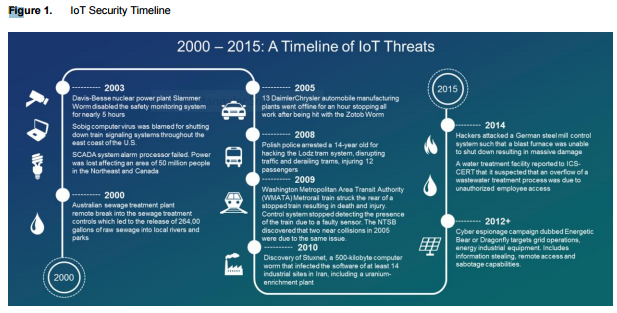
In the past year, we have seen:


Cisco: IoT Security Timeline

Who are these "Malicious People" and why do they want to wreak havoc with our Inventions?


IoT devices and systems are typically remote sensors or controls involved in managing a process of some sort. Whether it be collecting weather information for crop management, to sensor data for proper maintenance of an automobile, temperature and humidity information for building climate control, or bio sensors for monitoring a patients health, IoT devices manage a large amount of critical information.  Critical information that could potentially be considered Private and/or Confidential in nature. 

IoT PenguinBot
By the remote nature of these devices, they are also typically designed to be "low cost" and "low energy" battery operated systems.  Function and performance are the critical design success factors, while Security has not played a significant development role to date.  MOST current IoT devices are readily exploitable through several means. 

Oh, and did I mention that most IoT devices are connected (and trusted) in some way to logging, monitoring, and analysis tools deep within the corporate infrastructure?  Find a kink in this light armour, and you can sail right past the corporate security systems in place.

What type of attacker is interested in exploiting IoT devices?  We are finding that the IoT Threat Landscape is quite varied.  Everyone from cybercriminals to government entities, hacktivists, and even insiders have shown up to the game. It's apparently hard to resist the low hanging fruit of an easily exploitable system, that could lead directly into the corporate infrastructure.  

From stealing sensitive data by hacking IoT devices, to facilitating denial of service against a third-party entity, there are plenty of reasons and opportunities to exploit a connected Internet of Things device.


So, as developers, what are we to do? 

How can we ensure that our products are secure from the beginning?  What aids do we have to guide us in creating a more secure, more private consumer product?


I'm glad you asked!  There are many initiatives currently to define the obstacles and opportunities to creating a secure Internet of Things ecosystem, but there ARE some guideline that you can follow.


First, from Cyber Security company I am the Cavalry, here is a snippet of sage advice:

Security:

  1. Secure by Default
    1. No default passwords shared between devices, or weak out of the box passwords.
    2. All passwords should be randomly created using a high quality random password generator.
    3. Advanced features used by small percentage of users should be turned off by default(VPN,Remote Administration, etc...)
  2. Secure by Design
    1. Firmware should be locked down so serial access is not available.
    2. Secure Ethernet (SE) or Trusted Protection Modules (TPM) devices should be used to protect access to the firmware and hardware.
    3. All GPIO, UART, and JTAG interfaces on the hardware should be disabled for production versions.
    4. NAND or other memory/storage mediums should be protected with epoxy, ball sockets (so the memory cannot be removedand dumped), or other methods to prevent physical attack. 
  3. Self Contained Security
    1. The devices should not rely on the network to provide security. Rather, the device's security model should assume the network is compromised, and still maintain protection methods. This can be done with prompts to the user to accept handshakes between devices trying to access other devices on their networks.
    2. Communication between devices should be encrypted to prevent MiTM attacks and sniffing/snooping.
Privacy:
  1. Consumer PII not shared with manufacturers or partners.
  2. Usage data on individual consumer is never shared with partners or advertisers.
  3. Anonymous data for buckets of users on usage patterns is acceptable as long as it's proven to no be traceable back to an individual consumer.
  4. Data collection policy, type of data collected and usage of data is clearly documented on site.


As well, I am the Cavalry has published the Five Star Automotive Cyber Safety Program, with the purpose of bringing the industry together to standardize on a security framework for connected devices.


According to their website:  
The OWASP Internet of Things Project provides information on:

Of interest in this discussion is the topic of "IoT Attack Surface Areas". Each one of these boxes identifies specific threat vectors to IoT product development, as well as guidance and recommendations on remediating these concerns early in the development cycle.


Ecosystem Access Control Device
Memory
Device Physical
Interfaces
Device Web
Interface
Device
Firmware
Device Network
Services
Administrative
Interface
Local
Data Store
Cloud Web
Interface
Ecosystem
Communications
Vendor Backend
APIs
Third Party
Backend API's
Update
Mechanism
Mobile
Application
Network
Traffic


 IoT Security != Device Security


Attack Surface Vulnerability
Ecosystem Access Control
  • Implicit trust between components
  • Enrollment security
  • Decommissioning system
  • Lost access procedures
Device Memory
  • Cleartext usernames
  • Cleartext passwords
  • Third-party credentials
  • Encryption keys
Device Physical Interfaces
  • Firmware extraction
  • User CLI
  • Admin CLI
  • Privilege escalation
  • Reset to insecure state
  • Removal of storage media
Device Web Interface
  • SQL injection
  • Cross-site scripting
  • Cross-site Request Forgery
  • Username enumeration
  • Weak passwords
  • Account lockout
  • Known default credentials
Device Firmware
  • Hardcoded credentials
  • Sensitive information disclosure
  • Sensitive URL disclosure
  • Encryption keys
  • Firmware version display and/or last update date
Device Network Services
  • Information disclosure
  • User CLI
  • Administrative CLI
  • Injection
  • Denial of Service
  • Unencrypted Services
  • Poorly implemented encryption
  • Test/Development Services
  • Buffer Overflow
  • UPnP
  • Vulnerable UDP Services
  • DoS
Administrative Interface
  • SQL injection
  • Cross-site scripting
  • Cross-site Request Forgery
  • Username enumeration
  • Weak passwords
  • Account lockout
  • Known default credentials
  • Security/encryption options
  • Logging options
  • Two-factor authentication
  • Inability to wipe device
Local Data Storage
  • Unencrypted data
  • Data encrypted with discovered keys
  • Lack of data integrity checks
Cloud Web Interface
  • SQL injection
  • Cross-site scripting
  • Cross-site Request Forgery
  • Username enumeration
  • Weak passwords
  • Account lockout
  • Known default credentials
  • Transport encryption
  • Insecure password recovery mechanism
  • Two-factor authentication
Third-party Backend APIs
  • Unencrypted PII sent
  • Encrypted PII sent
  • Device information leaked
  • Location leaked
Update Mechanism
  • Update sent without encryption
  • Updates not signed
  • Update location writable
  • Update verification
  • Malicious update
  • Missing update mechanism
  • No manual update mechanism
Mobile Application
  • Implicitly trusted by device or cloud
  • Username enumeration
  • Account lockout
  • Known default credentials
  • Weak passwords
  • Insecure data storage
  • Transport encryption
  • Insecure password recovery mechanism
  • Two-factor authentication
Vendor Backend APIs
  • Inherent trust of cloud or mobile application
  • Weak authentication
  • Weak access controls
  • Injection attacks
Ecosystem Communication
  • Health checks
  • Heartbeats
  • Ecosystem commands
  • Deprovisioning
  • Pushing updates
Network Traffic
  • LAN
  • LAN to Internet
  • Short range
  • Non-standard


As stated earlier, this is starting guidance on what to look for when building out your Internet of Things Security Framework.  For further ideas and guidance, please read the references below. 

Good luck, and happy coding.


Resources:

OWASP: Top 10 IoT Security Issues
OWASP Top Ten IoT Security - Infographic
OWASP: IoT Security Guidance
RSA Conf: Mapping the IoT Attach Surface Areas
ARSTechnica: “Internet of Things” security is hilariously broken and getting worse
ARSTechnica: Police body cams found pre-installed with notorious Conficker worm
ARM.COM: From Sensor to Server, ARM drives the Internet of Things 
Texas Instruments: Internet of Things - Opportunities and Challenges 
DEFCON 23: IoT Attack Surface Mapping
HPE: Securing the IoT
Capgemini: Securing the Internet of Things
Globe and Mail: Internet of Things a playground for hackers
Globe and Mail: The Future is Smart - Why privacy must be baked into the Internet of Things
https://www.iamthecavalry.org/
IamtheCavalry: Five Star Automotive Cyber Safety Program
https://www.theguardian.com/technology/2015/nov/26/hackers-can-hijack-wi-fi-hello-barbie-to-spy-on-your-children
http://www.computerworld.com/article/2476599/cybercrime-hacking/black-hat-nest-thermostat-turned-into-a-smart-spy-in-15-seconds.html
https://www.exploitee.rs/index.php/Exploiting_Nest_Thermostats
http://www.theregister.co.uk/2016/01/12/ring_doorbell_reveals_wifi_credentials/
Embedded: Security framework for IoT devices
NIST Releases Draft Framework on the Internet of Things
Online Trust Alliance: IoT Trust Framework
WolfSSL: Embedded SSL Library for Applications, Devices, IoT, and the Cloud
http://www.bankingexchange.com/news-feed/item/5770-5-hacks-into-your-internet-of-things-devices
https://www.helpnetsecurity.com/2016/05/09/internet-of-fail/
Cisco: IoT Threat Environment
https://blog.knowbe4.com/worlds-most-famous-hacker-kevin-mitnick-iot-is-exploitable
http://krebsonsecurity.com/2016/02/this-is-why-people-fear-the-internet-of-things/


Wednesday, 14 October 2015

What is a Security Governance Review, and why do I need one?

Regardless of what service or product your company produces, Information is your most critical asset. The organization, management, and protection of that data could make or break your ability to stay operational in today's corporate environment.

Many high-profile organizational failures over the past several years have driven home the requirement to adopt appropriate Information Systems policies, processes, and standards.

Privacy requirements, regulatory compliance, shareholder and customer transparency are all mandating a more mature approach to Information Security.

Your corporate reputation and well being depend on your ability to manage, organize, and protect your Information Assets.


This article, and the next few, will try at a high level to explain the various tools we can use to assess and document your roadmap to Information Security Maturity.


Let's start with the definition of an Information Security Governance Maturity Model:
An Information Security Governance Maturity Model is a representation of how well your company understands, organizes, manages, and maintains security controls and processes specific to your Corporate Information assets.

There are a few models to chose from, but the Industry accepted standard is the 6-level COBIT maturity model, which is based on work pioneered at the Software Engineering Institute at Carnegie Mellon, to evaluate each of the ISO 27002:2013 security control groups.   

That said, the ISO 27002:2013 security control groups, in and of themselves are the Industry Standard set of controls - based on 18 specific sections - that provide guidance in protecting your corporate assets.

The COBIT definitions for the 6 levels of maturity are:

0 – Non-existent – Management processes are nonexistent or not applied

  • Complete lack of any recognizable processes. The organization has not even recognized that there is an issue to be addressed.

1 – Initial – Processes are ad hoc and disorganized

  • There is evidence that the organization has recognized that the issues exist and need to be addressed. There are, however, no standardized processes but instead there are ad hoc approaches that tend to be applied on an individual or case by case basis. The overall approach to management is disorganized.

2 – Repeatable – Processes follow a regular pattern
  • Processes have developed to the stage where similar procedures are followed by different people undertaking the same task. There is no formal training or communication of standard procedures and responsibility is left to the individual. There is a high degree of reliance on the knowledge of individuals and therefore errors are likely.
3 – Defined – Processes are documented and communicated
  • Procedures have been standardized and documented, and communicated through training. However, it is left to the individual to follow these processes, and it is unlikely that deviations will be detected. The procedures themselves are not sophisticated but are the formalization of existing practices.
4 – Managed – Processes are monitored and measured
  • It is possible to monitor and measure compliance with procedures and to take action where processes appear not to be working effectively. Processes are under constant improvement and provide good practice. Automation and tools are used in a limited or fragmented way.
5 – Optimized – Best practices are followed and automated
  • Processes have been refined to a level of best practice, based on the results of continuous improvement and maturity modeling with other organizations. Information technology is used in an integrated way to automate the workflow, providing tools to improve quality and effectiveness, making the enterprise quick to adapt.

To understand where your company sits with respect to each of the ISO 27002:2013 security control groups, you would engage a non-biased 3rd party to conduct a Security Governance Review. This review would be an immersive engagement between the Security Assessors and various members of your organization. Everyone from Human Resources, Privacy, IT administrators, Network Administrators, Database Administrators, Software Developers, Project and Change Managers, Internal Auditors, and Corporate Executive.

A Security Governance Review  (SGR) provides guidance for Corporate Executives and Board of Directors in establishing and maintaining an appropriate Information Security programme within your company.

A Security Governance Review provides critical feedback regarding the adequacy of existing controls and safeguards in maintaining your security posture.  This feedback can provide guidance in the reduction and/or mitigation of Information Security risks within the company.

Typically, this report would consist of a high level executive summary of your organization's maturity levelsacross the ISO security domains, compared to peers in your particular industry.  Remediation recommendations and a roadmap to completion would usually be included.  Most Security assessors would also deliver the detailed ISO27002:2013 working sheets with which the domains have been assessed.

The Radar Map to the right represents a sample posture map compared to a baseline of your industry.


This chart illustrates, by ISO 27002:2013 control area, the areas which Acme Widgets Inc. is performing at a evaluated level to its industry peers (yellow within the red boundary), and the areas which Acme Widgets Inc. is evaluated to be performing at a level below its industry peers (yellow outside the red boundary), as along with the relative degree of effort required to accomplish improvements (more yellow exposed = more effort).


You will want to periodically (annually?) review this maturity model to ensure that you are on track as things change both outside and within your organization. This periodic review will allow you to show metrics regarding your security governance programme growth.


In future posts, we will be discussing the following:
  • What is a Threat Risk Assessment?

  • What is a Privacy Impact Assessment?

  • What is a Vulnerability Assessment?

  • What is a Penetration Test?


Sections of the ISO27002:2013 
 5. Security Policy Management
 6. Corporate Security Management
 7. Personnel Security Management
 8. Organizational Asset Management
 9. Information Access Management
10. Cryptography Policy Management
11. Physical Security Management
12. Operational Security Management
13. Network Security Management
14. System Security Management
15. Supplier Relationship Management
16. Security Incident Management
17. Security Continuity Management
18. Security Compliance Management


References:


ISACA: Information Security Governance Guidance for Boards of Directors and Executive Management
Comparing different information security standards: COBIT vs. ISO 27001  
ISACA: Assessing IT Security Governance Through a Maturity Model and the Definition of a Governance Profile 
ISO 27002:2013 in plain English.
ISO/IEC 27002:2013 Information technology — Security techniques -Code of practice for information security controls 
Wikipedia: ISO27002 
http://www.securityprocedure.com/control-objectives-information-and-related- technology-cobit 


Friday, 25 September 2015

From Blueline to BlueZone - PCI Tokenization Matures

Last year, I wrote about a new Canadian company that had entered the Compliance Appliance market space.  Blueline Data had developed a tokenization gateway that would help you define and isolate your PCI compliance scope boundary.  This isolation was not only for Point Of Sale and Web Merchant portals (Shopping portal), but for Telephony and Unified Communications traffic as well!  This was a revolutionary step in this industry. Several other companies had tokenization systems available for structured and/or unstructured data, however no one had a viable solution that would also cover voice and unified communications. 


A lot has gone on in the past year, and I decided to revisit them, to see where their technology has progressed...


Last year, Forrester issued a paper defining the requirements necessary to secure data into the future, and discussing the technologies that will get us there. The Document titled "TechRadar™: Data Security, Q2 2014", states clearly that you need to:


  • Restrict and strictly enforce access control to data. This includes denying access to unauthorized persons or blocking their attempts to gain access.
  • Monitor and identify abnormal patterns of network or user behavior. This includes tools that analyze traffic patterns and/or monitor user behavior to detect suspicious anomalies (e.g., improper or excessive use of entitlements such as bulk downloads of sensitive customer information).
  • Block exfiltration of sensitive data. These are tools or features of tools that detect, and optionally prevent, violations to policies regarding the use, storage, and transmission of sensitive data.
  • Render successful theft of data harmless. Once you’ve identified your most sensitive data, the best way to protect it is to “kill” it.6 “Killing” data through encryption, tokenization, and other means renders the data unreadable and useless to would-be cybercriminals who want to sell it on the underground market.


The first three have been the bread and butter of the Information Security industry for the past 20 years or so.  From firewalls and both signature and heuristics based Intrusion Detection/Prevention, to Data Loss Prevention systems, the industry has been diligently protecting our perimeters.


It's that fourth one that I'm interested in here.  "Render successful theft of data harmless."  In other words, replace any valuable data such as Payment Card Info, Personal Health Info, Social Insurance Numbers, etc... with a "token" that has no value to would be thieves. These tokens can be made to preserve the format requirements of the original data, so as not to break backend processing, as well as including search/index criteria. 


To properly provide security through tokenization, one must be able to implement it not only on the server side for data at rest, but also for data in transit, as well as at the client side, such that the relevant sensitive data never even leaves the client's network.


What if, there was a service... APIs that could provide tokenization either at the client browser, or as data is passed to cloud apps?


I know that I'm not new to this train-of-thought, but the cost of non-compliance is growing exponentially. 
Financial Damage can be insured against... Reputational damage cannot.


As I said... a lot has gone on in the past year.  Blueline has matured from just providing on-premise gateway appliances, to hosting Compliance Services in the cloud.  

Blueline is about to introduce several hosting options.  You can still get on-premise control if that is what you desire, but that has been augmented with  co-located gateway services as well as true Cloud based "Compliance as a Service"  Tokenization/Encryption through APIs. 

Another move that Blueline has made it to provide "Diskless Tokenization".  Typically, tokenization services keep a very secure database in a cryptographic vault.  This database would include a table of  sensitive data to token pairs that are used to index and manage the tokens.  Across the industry,  customers have expressed concern over having this database, even though it is protected in a vault.  Complaints from too much residual risk, to database latency in very large token pair tables (tens or hundreds of millions of pairs) have driven out an alternate solution.

Blueline has introduce a diskless solution that creates a "derived" token using a one time pad, without the need for the data/token pairs to be stored. These derived tokens, can be recalculated from some secret value that do not need to be stored in a database.


Blueline has created two new offerings:

bluegrid™ is a turnkey solution for  "Compliance in a Box".  It is a standard 19" cabinet, consisting of a series of redundant "bluenodes™" that provide the various security, and compliance services required for a self contained Compliance DMZ. It can be installed in your own data center, or hosted externally for you.  Applying the "Zero Trust" model, bluegrid™ encapsulates your sensitive application environment and provides a full security stack to protect that environment, from firewall, IPS, authentication store, tokenization, encryption, logging and storage.


A standard bluegrid™ rack would consist of a mix of the following bluenode™ appliances:

bluenode tx - Traffic Manager (zero-impact deployment)
bluenode dx - Data Gateway (financial network integration)
bluenode cx - Cyber Vault (diskless tokenization, encryption)
bluenode ix - Identity Manager (device and service access)
bluenode ex - Event Manager (logging and event analytics)
bluenode sx - Storage Block (low-latency shared storage)


bluegrid™ can centralize and limit most of your PCI compliance scope to a single rack in the data center. (Point-of-Sale systems excluded)


bluezone™ takes this one step further, providing a Cloud based Security Infrastructure - leveraging APIs to isolate the sensitive data outside of your IT environment and enabling secure financial or other confidential data processing and exposing the following security services: 
  • Tokenization–replacement of the original sensitive data with a risk-free replica for secure transmission, processing or storage
  • Encryption–military-grade cryptographic protection of digital content
  • Key Management–cryptographic key storage and lifecycle control
  • Payment Gateway–secure real-time and offline merchant acquirer processing of tokenized e-commerce and m-commerce transactions
  • Credit Scoring–secure personal or commercial credit check against a credit bureau, reference agency or central bank
  • Address Verification–secure cardholder address validation
  • Issuer Reconciliation–transaction batch transfer to issuer bank
  • Digital Wallet–secure checkout for merchant commerce sites and mobile applications with the e-wallet payment method
bluezone™ can effectively remove most of your PCI compliance scope from your environment altogether.(Point-of-Sale systems excluded)


Forrester TechRadar report on Data Security Q2 2014 clearly shows Tokenization having "Significant Success" in securing sensitive data.


Resources:

http://security-musings.blogspot.ca/2015/03/tokenization-as-companion-to-encryption.html
http://www.itworldcanada.com/blog/toronto-upstart-brings-tokenization-protection-to-uc-web-pos/98109
https://www.forrester.com/TechRadar+Data+Security+Q2+2014/fulltext/-/E-res61547
http://www.mashery.com/blog/tokenization-and-api-gateways-future-mobile-commerce
http://www.mastercard.com/gateway/payment-processing/tokenization.html
https://www.pcicomplianceguide.org/how-you-can-use-tokenization-to-reduce-pci-scope/
http://www.protegrity.com/2012/02/differences-between-vault-based-tokenization-and-vaultless-tokenization/
http://www.protegrity.com/wp-content/uploads/2013/04/Protegrity-Vaultless-Tokenization-Fact-Sheet.pdf
https://securosis.com/blog/token-vaults-and-token-storage-tradeoffs
https://en.wikipedia.org/wiki/One-time_pad
https://en.wikipedia.org/wiki/Tokenization_(data_security)
https://www.voltage.com/technology/tokenization-and-key-management/hp-secure-stateless-tokenization/
http://www.trendmicro.co.uk/media/wp/kill-your-data-to-protect-whitepaper-en.pdf
http://www.bluelinex.com/trends.html
http://www.bluelinex.com/resources/blp204_osfi_compliance_sheet.pdf
http://www.bluelinex.com/resources/blp204_pci_compliance_sheet.pdf
http://www.bluelinex.com/resources/blp204_hipaa_compliance_sheet.pdf
http://searchcloudsecurity.techtarget.com/tutorial/PCI-and-cloud-computing-Cloud-computing-compliance-guide
http://www.crn.com/news/managed-services/300075263/2015s-big-opportunity-for-msps-compliance-as-a-service.htm
http://www.infoworld.com/article/2622986/risk-management/the-case-for-compliance-as-a-cloud-service.html